This is an excerpt from a presentation I made a few years ago at a national conference:
Patriarchy literally means “the rule of the fathers,” and its core concept is the idea that all men are born superior to all women. As Shulamith Firestone put it in her classic book, The Dialectic of Sex, this sexual class system, which in its purest form demands the literal enslavement of women and girls [see Nicholas Kristof's editorial in today's (11/30/08) New York Times on the prevalence of throwing acid in women's faces to punish them and keep them down in Pakistan, Afghanistan, etc., if you think female slavery is over], serves as the model for all other systems of oppression, such as racism and homophobia.
The key mode of patriarchy is domination. Scholar Riane Eisler has named patriarchy “dominator culture.” Dominator culture can conceive of power in only one form, as “Power Over” others. Every imaginable relationship, including that between parent and child, and that between lovers or spouses, is defined in terms of dominance and submission. Someone has to be “on top,” and someone else has to be “on the bottom.”
To make it easier to achieve this, dominator culture is saturated with dualism, a mode of thinking we are taught from the cradle. Dualism insists that everything boils down to an either/or choice – that you can never have your cake and eat it too. There are only two acceptable or possible answers to any given question, and these two answers are literally poles apart: polarized. They’re opposites. One answer is labeled entirely right and good, and the other is seen as entirely wrong and bad. Needless to say, dualism makes for gross over-simplifications and generalizations, and twists and distorts everything it touches. With a little bit of imagination, in most instances one can perceive a much broader spectrum of choices, and often more than a single option could be embraced. But that wouldn’t fit with the system of “tops” and “bottoms,” where one thing must always be “better” than another.
Patriarchal religions are used to justify and preach this system, and to legitimize the persecution and often extermination of those who resist it, both inside and outside a given culture. For the first two thousand years or so of patriarchy, these religions featured both Gods and Goddesses, but the “top god” in patriarchal religion was always male. The Goddesses were defined as wives, sisters, mothers, love interests or daughters of the male gods, to make sure that ordinary women didn’t get any ideas about freeing themselves from being defined as the possessions of men. For some patriarchs this didn’t go far enough, so about three thousand years ago they started to preach that there was only one god: male, of course. Eventually, several different religions of this type: male monotheism: developed. My friend the feminist art historian calls it “mono-male-theism.” However you prefer to arrange the syllables, the term proclaims: “Just For Men.”
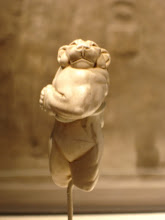
Patriarchy has been with us in the West – Europe and North America – for only about 5,000 years, give or take half a millennium or so. Human beings have existed for much longer than that: hundreds of thousands of years. Patriarchy entered a Europe where many other cultures already existed, cultures that operated with a very different kind of mind-set. These were what Riane Eisler calls “partnership societies.” Partnership societies were quite cooperative and evolved, with high levels of creative sophistication. Their social structures were generally matrilineal – that is, children traced their descent through their mother back to her mother and so forth. These cultures were comparatively non-violent: they did not “focus on the power to inflict pain and kill, but the power to give life and pleasure.”[i] Their religions centered around a Goddess. The earliest European and Middle Eastern images of the Divine Female are up to 400,000 years old.
These partnership cultures were not in the dark about how babies are conceived: they were aware of both the male and the female role in reproduction. Partnership spirituality usually thought of “the divine in both female and male form,” but “the male deities were not associated with thunderbolts or weapons (like Jehovah or Zeus)” and they were, at most, equal to the Goddesses. In partnership cultures, “masculinity was not synonymous with domination and conquest.”[ii]
Patriarchy is a recent human invention. Despite what its religions preach, it is not natural, it is not inevitable, and it has never been “the only thing that’s out there.” There are alternatives to it, and all human-made systems can be changed. In the relatively brief span of its existence, patriarchy has already gone just about the whole way toward proving itself unviable. This comes easily to dominator culture because it is fundamentally “anti-life,” so anti-life that it has made uncounted life-forms extinct and now threatens even the survival of the human species.
Dominator religions preach the unlimited exploitation of our planet Earth, proclaiming that the world was created for “man” to use, and use up if he so chooses, since some otherworldly Heaven or Paradise is his “real home.” Their expectation is that “mankind” will end by causing global disaster, that human beings are incapable of self-control and common sense. In my local paper in May 2002, one Mike Hosey, a Christian, confidently stated:
“Christianity, in general, believes the world to be a lost and dying place in need of salvation; a place where people need to put their faith in God, and not in themselves.”[iii]
I totally disagree with this view of the world and of humanity, and I believe there is real reason for hope. As Riane Eisler points out, in the West, over the past 300 years and more, a historical continuum has developed that is moving us away from absolute dominator culture.[iv] In the 17th and 18th centuries, the “divinely ordained” rule of kings and emperors over their “subjects” was challenged and largely overthrown. The early feminist movement in the 19th century chipped away at the control of men over women and children, while the abolitionist movement and pacifist movement challenged the entrenched traditions of the enslavement of one race by another, and the use of force by one nation to control another. In the past 100-plus years, civil rights, organized labor, anti-colonial, women’s liberation, indigenous people’s rights, and gay rights movements have arisen to oppose further aspects of domination. A relatively new and very important movement is now taking a stand against domination and violence in intimate relationships: rape, battering, child abuse and incest. Putting an end to intimate violence is central to moving toward a partnership society.
There is no mistaking that this “shift toward partnership has been fiercely resisted every step of the way.”[v] But if you look at the overall trend, we have moved a long distance away from all-out domination and toward partnership in a relatively short time. We are presently in a backlash phase, what Eisler calls a “periodic regression toward the dominator model.”[vi] Yet the irony of globalization is that the world has become so small that people cannot really avoid the knowledge of our mutual world-wide interdependence. We are being forced out of the denial that is typical of dominator culture by phenomena we cannot ignore, such as global warming. The world’s systems of domination are only able to escalate these problems, and as a result it is becoming inescapably obvious that these systems are counter-productive.
[i] Eisler, The Power of Partnership, p. 189
[ii] Eisler, p. 189
[iii] Mike Hosey, in an editorial on the sexual abuse scandal in the Roman Catholic church, The Gainesville Sun, May 20, 2002.
[iv] Eisler, pp. 94-95.
[v] Eisler, p. 95.
[vi] Eisler, p. 95.
Showing posts with label hierarchy. Show all posts
Showing posts with label hierarchy. Show all posts
Sunday, November 30, 2008

Saturday, November 29, 2008
On Marriage, continued
Something just struck me. I wrote in an earlier post about my objections to women taking their husbands' names upon marriage. Well, in one way this connects with my problems with societal homophobia. I believe that people are capable of remembering two or even more family names in connection with a single family unit, but many of them just aren't familiar with the concept and therefore bridle at it, or would rather be mentally lazy and slap the same label on both spouses and their kids. And many, whether consciously or subconsciously, subscribe to the idea that a woman should "be subsumed into" her husband upon marriage, as is the will of patriarchy.
Now, gay and lesbian couples are (blessedly, in my opinion -- they're a breath of fresh air within the New York Times Sunday Styles wedding announcements, see earlier post) very likely to include two or more names in their family unit. So maybe gay and lesbian couples are in somewhat of the same boat with heterosexual couples who retain two names instead of shoehorning both partners in under one name. Many folks claim they "can't handle it" when the truth often is, they don't want to handle it. They're using nomenclature as a means of social compulsion, to make straight women who want to maintain their independence, and gays and lesbians, disappear.
Of course it's not as simple as that. Homophobia is still far more socially acceptable than misogyny. Though misogyny remains too socially acceptable on its own account, if a straight woman, and her male partner, are willing to take on the extra work needful to make the world at large recognize the fact that they each have their own surname even though they're married, they can usually get pretty much everyone to go along with it. Some people may be obnoxious about it, and even attack you personally if they feel threatened enough, but if you don't cede ground, all but a handful will back down. Unfortunately, the same is not true for gays and lesbians seeking the plain old right to marry, much less recognition as a married couple. A straight woman who insists on her own name may get guff, but she won't get beaten up or killed. Gays and lesbians who refuse to pretend to be who they're not may actually get beaten up or killed, or lose their jobs, or be denied housing, or lose custody of their children... and a lot of other unpleasant, wrong and dangerous things. Not to mention that they run a very good chance of being abandoned, rejected and/or abused by their very own family members.
This is a strange time. We've managed to go a little ways toward getting past sexism and racism in our political choices, but at the same time, there's this "renaissance" (I would say recidivist slide) of women ostentatiously "taking their husband's names," and, far worse, a spate of benighted anti-gay legislation which has gone so far as to re-write state constitutions to deny the right of marriage to a specific group (on the basis of sexual orientation or preference), and also to deny the option of domestic partnership to heterosexuals who don't want to legally marry. The effect on my state, Florida, is catastrophic. First there's the despicable homophobia and anti-American tenor of the constitutional amendment passed here. And then there are the disastrous consequences for our senior-citizen-heavy population. Many single seniors live together without marriage because marrying means losing a significant part of their already pathetic Social Security benefits. Now they face not being able to register as domestic partners, which means they have no rights if a partner gets sick, no access to a partner's health benefits, etc. etc. Sickening.
Let me be clear on one point. If a woman desperately wants to change her name upon marriage, it's a free country. But the overwhelming trend of women "taking their husbands' names" is an ongoing expression of a pretty clearly discernible, long-standing patriarchal sentiment, which is that women are here to support and enable men (and children), and not to lead lives of their own or have goals of their own. This system has not redounded to the psychological or economic benefit of homemakers, whose vital work I think should be explicitly part of the Gross Domestic Product. Full-time homemakers of either gender should be awarded Social Security in their own right, not as derivatives of their spouses, and ideally, they should be officially allotted a given share of the annual family income, so they never have to beg, cajole or manipulate in order to get their hands on spending money. And don't get me going on so-called "no-fault" divorce, which seems to assume that someone who hasn't held a paid job for years can somehow jump right back into paid work! What very few people realize is that only about 15% of women who divorce are awarded ANY alimony at all, and as for child support, the frequency with which men skip out on paying it is disgusting.
But I digress. Which I do tend to do. To get back to the resistance of the larger society to both "two-name" heterosexual marriage and, far more aggravatedly, gay/lesbian marriage: of course, what both these options do is to undermine the paradigm of patriarchal marriage. They offer models of marriage that go against gender-role assumptions and assume equal partnerships instead of complementarity. A large percentage of our fellow citizens don't want to see, and don't want their children to see, that there are quite a few different ways to do coupledom, including ones which don't necessarily involve hierarchy, dominance/submission, procreation, or the "disappearing" of one partner into another. They want to force everyone into "one-size-fits-all" (it never does) gender roles and marriage molds, ones they find familiar and comforting, ones that don't require individual thought and don't necessitate the taking of individual responsibility or individual stands.
This is intimately connected to our culture's love of dualism, the idea that there are only two answers to any given question, one labeled "right" and one labeled "wrong." Every situation is reduced to an "either-or" choice, with no option labeled "both-and." More on this next time.
Now, gay and lesbian couples are (blessedly, in my opinion -- they're a breath of fresh air within the New York Times Sunday Styles wedding announcements, see earlier post) very likely to include two or more names in their family unit. So maybe gay and lesbian couples are in somewhat of the same boat with heterosexual couples who retain two names instead of shoehorning both partners in under one name. Many folks claim they "can't handle it" when the truth often is, they don't want to handle it. They're using nomenclature as a means of social compulsion, to make straight women who want to maintain their independence, and gays and lesbians, disappear.
Of course it's not as simple as that. Homophobia is still far more socially acceptable than misogyny. Though misogyny remains too socially acceptable on its own account, if a straight woman, and her male partner, are willing to take on the extra work needful to make the world at large recognize the fact that they each have their own surname even though they're married, they can usually get pretty much everyone to go along with it. Some people may be obnoxious about it, and even attack you personally if they feel threatened enough, but if you don't cede ground, all but a handful will back down. Unfortunately, the same is not true for gays and lesbians seeking the plain old right to marry, much less recognition as a married couple. A straight woman who insists on her own name may get guff, but she won't get beaten up or killed. Gays and lesbians who refuse to pretend to be who they're not may actually get beaten up or killed, or lose their jobs, or be denied housing, or lose custody of their children... and a lot of other unpleasant, wrong and dangerous things. Not to mention that they run a very good chance of being abandoned, rejected and/or abused by their very own family members.
This is a strange time. We've managed to go a little ways toward getting past sexism and racism in our political choices, but at the same time, there's this "renaissance" (I would say recidivist slide) of women ostentatiously "taking their husband's names," and, far worse, a spate of benighted anti-gay legislation which has gone so far as to re-write state constitutions to deny the right of marriage to a specific group (on the basis of sexual orientation or preference), and also to deny the option of domestic partnership to heterosexuals who don't want to legally marry. The effect on my state, Florida, is catastrophic. First there's the despicable homophobia and anti-American tenor of the constitutional amendment passed here. And then there are the disastrous consequences for our senior-citizen-heavy population. Many single seniors live together without marriage because marrying means losing a significant part of their already pathetic Social Security benefits. Now they face not being able to register as domestic partners, which means they have no rights if a partner gets sick, no access to a partner's health benefits, etc. etc. Sickening.
Let me be clear on one point. If a woman desperately wants to change her name upon marriage, it's a free country. But the overwhelming trend of women "taking their husbands' names" is an ongoing expression of a pretty clearly discernible, long-standing patriarchal sentiment, which is that women are here to support and enable men (and children), and not to lead lives of their own or have goals of their own. This system has not redounded to the psychological or economic benefit of homemakers, whose vital work I think should be explicitly part of the Gross Domestic Product. Full-time homemakers of either gender should be awarded Social Security in their own right, not as derivatives of their spouses, and ideally, they should be officially allotted a given share of the annual family income, so they never have to beg, cajole or manipulate in order to get their hands on spending money. And don't get me going on so-called "no-fault" divorce, which seems to assume that someone who hasn't held a paid job for years can somehow jump right back into paid work! What very few people realize is that only about 15% of women who divorce are awarded ANY alimony at all, and as for child support, the frequency with which men skip out on paying it is disgusting.
But I digress. Which I do tend to do. To get back to the resistance of the larger society to both "two-name" heterosexual marriage and, far more aggravatedly, gay/lesbian marriage: of course, what both these options do is to undermine the paradigm of patriarchal marriage. They offer models of marriage that go against gender-role assumptions and assume equal partnerships instead of complementarity. A large percentage of our fellow citizens don't want to see, and don't want their children to see, that there are quite a few different ways to do coupledom, including ones which don't necessarily involve hierarchy, dominance/submission, procreation, or the "disappearing" of one partner into another. They want to force everyone into "one-size-fits-all" (it never does) gender roles and marriage molds, ones they find familiar and comforting, ones that don't require individual thought and don't necessitate the taking of individual responsibility or individual stands.
This is intimately connected to our culture's love of dualism, the idea that there are only two answers to any given question, one labeled "right" and one labeled "wrong." Every situation is reduced to an "either-or" choice, with no option labeled "both-and." More on this next time.
Sunday, November 23, 2008
An Introduction to (Neo-)Paganism
Here's a brief piece I wrote for a panel discussion at a college reunion, almost ten years ago:
Starting in 1991, I came back to the belief system I think I was born with. It's called Goddess spirituality, eco-spirituality, eco-feminism -- the big, catch-all term is Neo-Paganism. None of these names fit completely, and some of the words are given a negative spin by popular culture.
It's partly rooted in ever-growing amounts of archaeological evidence of non-patriarchal pre-Christian cultures in Africa, Asia, and Europe. These societies, which existed for hundreds, sometimes thousands of years, were egalitarian, co-operative, highly creative and largely peaceful. They saw the spark of the divine in everything living, and when they personified this divine essence, they called it Goddess -- later, they also called it God.
For me, it's also a personal re-connection to remembered moments in my childhood, experiences of wonder, times when I felt good about myself and the whole world, energized, 100 per cent alive.
But it's not all “going back.” My belief system rejects dualism, the idea that something must be either "this" or "that" -- so it can reach back and look forward at the same time. Neo-Paganism makes no claim to being some "authentic" revival of specific beliefs from 3,500 or more years ago. After all, it's Neo-Paganism, and it's about living in this, present world. It's about remaining aware of both the wider world, and the specific places we each live in: their seasons, climate, and geography, and the needs of that particular community. Because we insist on honoring where we are, what we come from and what we've become a part of, Neo-Pagans come in at least as many flavors as Baskin-Robbins Ice Cream -- but we DO share some basic principles.
First, to Neo-Pagans, the divine is immanent, NOT transcendent. It's not somewhere "above" us humans and the rest of the world, or "out there" -- it IS, and it IS in EVERYTHING, including us. All creation is born of a Great Mother and is part of Her substance, so everything is connected.
Second, Neo-Pagans accept no cast-in-stone hierarchies, and no all-powerful gurus. It's a woman-positive belief system -- for example, since we believe in Goddess, we can't well question women's right to be priestesses -- but it's not a belief system for women only. For men and women, Neo-Paganism gives the opportunity to explore and integrate all aspects of one's personality, to "think outside the box." We're also called to live in the body -- live juicy and messy, without denying the body and the emotions, without seeing the mind and spirit as separate from the body, superior or somehow more "pure." I believe I get one life, one wonderful gift, one chance to experience this beautiful world, through the medium of my body -- and I am grateful to my body, and love it.
At the same time, Neo-Paganism is a very demanding belief system. It's not about unlimited license or moral relativism. The one binding rule, the Wiccan Rede, could be called "How to be Stricter than the Ten Commandments in Eight Words or Less." It says, "IF you harm NONE, do as you will." Think about it. I am to harm nothing -- not myself, or anyone or anything else. So I'm required to "live lightly on the earth", to be constantly aware of the obvious and not so obvious impact of my actions. I have to take responsibility for everything I do, and examine and recognize the amazing power of my intentions and my expectations.
You can see why this is unlikely to become a majority religion! It's a lifelong learning process, without any promise of a future repeat performance. But it suits me, and quite a few others: there are now [1999] at least 200,000 Neo-Pagans in the United States alone.
Starting in 1991, I came back to the belief system I think I was born with. It's called Goddess spirituality, eco-spirituality, eco-feminism -- the big, catch-all term is Neo-Paganism. None of these names fit completely, and some of the words are given a negative spin by popular culture.
It's partly rooted in ever-growing amounts of archaeological evidence of non-patriarchal pre-Christian cultures in Africa, Asia, and Europe. These societies, which existed for hundreds, sometimes thousands of years, were egalitarian, co-operative, highly creative and largely peaceful. They saw the spark of the divine in everything living, and when they personified this divine essence, they called it Goddess -- later, they also called it God.
For me, it's also a personal re-connection to remembered moments in my childhood, experiences of wonder, times when I felt good about myself and the whole world, energized, 100 per cent alive.
But it's not all “going back.” My belief system rejects dualism, the idea that something must be either "this" or "that" -- so it can reach back and look forward at the same time. Neo-Paganism makes no claim to being some "authentic" revival of specific beliefs from 3,500 or more years ago. After all, it's Neo-Paganism, and it's about living in this, present world. It's about remaining aware of both the wider world, and the specific places we each live in: their seasons, climate, and geography, and the needs of that particular community. Because we insist on honoring where we are, what we come from and what we've become a part of, Neo-Pagans come in at least as many flavors as Baskin-Robbins Ice Cream -- but we DO share some basic principles.
First, to Neo-Pagans, the divine is immanent, NOT transcendent. It's not somewhere "above" us humans and the rest of the world, or "out there" -- it IS, and it IS in EVERYTHING, including us. All creation is born of a Great Mother and is part of Her substance, so everything is connected.
Second, Neo-Pagans accept no cast-in-stone hierarchies, and no all-powerful gurus. It's a woman-positive belief system -- for example, since we believe in Goddess, we can't well question women's right to be priestesses -- but it's not a belief system for women only. For men and women, Neo-Paganism gives the opportunity to explore and integrate all aspects of one's personality, to "think outside the box." We're also called to live in the body -- live juicy and messy, without denying the body and the emotions, without seeing the mind and spirit as separate from the body, superior or somehow more "pure." I believe I get one life, one wonderful gift, one chance to experience this beautiful world, through the medium of my body -- and I am grateful to my body, and love it.
At the same time, Neo-Paganism is a very demanding belief system. It's not about unlimited license or moral relativism. The one binding rule, the Wiccan Rede, could be called "How to be Stricter than the Ten Commandments in Eight Words or Less." It says, "IF you harm NONE, do as you will." Think about it. I am to harm nothing -- not myself, or anyone or anything else. So I'm required to "live lightly on the earth", to be constantly aware of the obvious and not so obvious impact of my actions. I have to take responsibility for everything I do, and examine and recognize the amazing power of my intentions and my expectations.
You can see why this is unlikely to become a majority religion! It's a lifelong learning process, without any promise of a future repeat performance. But it suits me, and quite a few others: there are now [1999] at least 200,000 Neo-Pagans in the United States alone.
Subscribe to:
Posts (Atom)